hen Tony Hall was released from detention in 2012, his family rallied around to support him. One of his five older sisters said he could stay with her for a while. A nephew printed business cards and designed a website for him so he could advertise his services as a painter and decorator, to make the most of the vocational training he received while he served his prison sentence.
But for 14 years he has been unable to make use of the cards because of a Home Office decision that he should be deported. All this time he has been kept on a deportation list, which means he cannot work, rent somewhere to live, receive benefits or do anything that would allow him to start rebuilding his life. Instead, he remains on the edge of destitution, reliant on the kindness of family and friends to survive.
Eight years ago, when the Windrush scandal erupted into the national consciousness, it triggered the resignation of the then-home secretary Amber Rudd. Subsequently, there were a string of repeated promises to right the wrongs done to a group of people who migrated to Britain from Caribbean Commonwealth countries in the 1950s and 1960s, and to their children who often followed later, and were wrongly treated as illegal immigrants despite having a right to live in the UK.
But for some, justice has been elusive, particularly for those who appear, in the eyes of the Home Office, to be the wrong kind of victim.
On paper, Hall doesn't instantly present as a straightforward, heartstring-tugging case study. In 2001 he was convicted of a serious crimeconspiracy to rob and having a firearm with intent; he spent eight years in prison. He had been planning with friends to hold up a security van taking money to a bank; he was carrying a toy gun, but there was also a real gun in the car. Police stopped them before a crime was committed.
His case is complex, but when successive governments promised to resolve the problems that the Home Office created for members of the Windrush generation, they didn't restrict themselves to putting right only the difficulties experienced by people with uncomplicated lives. The principle of rehabilitation suggests that Hall, having served his sentence, should then have been allowed to restart his life, as his co-defendants did.
Since his release from prison, Hall, 62, who was born in Barbados, but who has lived in Britain since travelling here at the age of 12 in 1976, has been trying to persuade the Home Office that deportation to a country he has not visited for half a century is unreasonable. So far, his efforts have been in vain.
Every fortnight Hall must attend an appointment at a Home Office reporting centre, carrying a document printed with his mugshot above a letter that warns him he is liable to be detained "pending a decision to deport you/because a decision has been made to deport you". The journey there takes him the best part of two hours, and involves a few stops on the overground, a short bus ride, then six stops on the underground and another bus ride, followed by a queue at the reporting centre, a brief checking of documents and the reverse trip home. By now, he estimates that he has performed this time-consuming ritual more than 350 times.
The fortnightly reporting requirement is often imposed on people who have claimed asylum, or have other unresolved immigration issues, to prove that they are complying with the Home Office rules. It is a stressful process because each time you visit the centre, you could, in theory, be arrested and taken to a detention centre ahead of deportation. It is extremely rare for this state of limbo to continue for more than a decade. Hall has mostly given up trying to discuss his situation with the officials who sign him in.
"Sometimes I feel mad at them," he says. "I tell them: 'I've been here for 50 years.' They say: 'That's not my department. We're not here to do your case.'"
Hall acknowledges that he behaved stupidly as a younger man. But he also points out that he has served a long sentence and despairs at still being unable to start afresh. When his sentence was over, he was transferred to immigration detention and, in January 2010, the Home Office put him on a flight to Barbados. He was returned to London on the same plane, arriving back the following day, because border officials in Barbados refused to let him into the country; they appear to have been unwilling to issue him with papers to enter because of the length of time he had been in the UK.
His memories of Barbados are hazy and he has no surviving relatives there. When he sees photographs of the island he recognises nothing; the idea of being deported there seems absurd to him, but UK officials refuse to lift the order, even though it seems unlikely that it can ever be enforced. When he was imprisoned in 2001, his flat was emptied by the council and his belongings thrown away; he has no paperwork tying him to either country, and is effectively stateless.
Like most people affected by the Windrush scandal, Hall's difficulties with his immigration status go back to mistakes or oversights made by officials decades ago. For him to fully explain his situation requires him to set out his life story in a way that can feel uncomfortably exposing. Hall wants people to read these details because he hopes that it might finally nudge someone within the Home Office to exercise discretion and lift the deportation order that has hampered his life for 14 years. It is a story that, like the life stories of most people affected by the Windrush scandal, closely tracks Britain's colonial past and its shifting attitudes towards immigration.
Hall was born in a rural area of Barbados, and was brought up by his grandparents because his mother was living in London with his stepfather, who was working as a mechanic for British Rail. Saving money from her job in a Gordon's Gin factory, she gradually brought her children over to join her in London, first his five older sisters, and finally in 1976, her youngest child, Tony.
His early childhood in Barbados was not particularly warm, as a left-behind "barrel child" (the term for that generation of children, left in the Caribbean with relatives, waiting for parcels containing clothes and food sent from their parents in England in barrels). His grandparents had a small farm with some sheep and pigs, and he had to help out. He remembers going to school smelling of pig manure and being teased by other children. He arrived in Britain with a strong Barbadian accent and a pronounced stammer, which he still has.

Initially, he found it hard to acclimatise. He struggled to fit in at the large north London secondary school where his older sisters were studying. "People couldn't understand what I was saying. I'm not embarrassed by my stammer now, but it was quite hard then." He says he was relaxed about the high levels of casual racism he encountered at the school, where there were shouts of "Black bastard". "They were just kids," he says.
He was sent to a speech therapist and, because he was so unsettled, later dispatched to live in a children's home. After committing some minor crimes, he was then sent to borstal. "I think I was a bit disturbed. It was difficult, my sisters leaving one by one, being left with my grandparents. I played up a lot," he says. "When I was young I was a bit of a tearaway; I was a pain. Once you get into trouble, it's hard to get out." Most of it was "silly petty stuff", he says. "I've paid the price. I've grown up a bit."
There have been significant positive developments since Theresa May's apology for the Home Office's treatment of the Windrush generation in 2018; more than 18,000 people have subsequently been issued with documentation, confirming their right to remain in the United Kingdom, and about £132m in compensation has been paid out to 4,177 people who were misclassified as immigration offenders, and lost their jobs or their homes as a result, or in extreme cases were wrongly deported or arrested.
But a significant number of people are still coming up against Home Office intransigence as they try to sort out historic problems. Since Rudd resigned over the scandal in April 2018, Britain has had to learn the names of seven new home secretaries, each with a different approach to tackling the fallout. Sajid Javid set up a Windrush unit with a view to resolving the difficulties experienced by those affected. In 2023, Suella Braverman closed it down. A year later Yvette Cooper re-established the team. In its 2024 election manifesto, Labour promised: "We will ensure the victims of the appalling Windrush scandal have their voices heard."
Some people, like Hall, are still struggling to get anyone to listen.
Martin Forde is a barrister who has been working to support people affected by the scandal since designing the compensation scheme in 2019. "Compassion is not exactly their middle name," he says of the Home Office, expressing frustration at the number of people still encountering problems.
"My strong suspicion is that there are many of these cases; many will be people of no fixed abode who won't want to put their head above the parapet," he says. He is troubled by the second punishment often meted out to people with precarious immigration status, when they break the law. "It goes against a sense of fairness to have this double jeopardy."
For the moment, Hall lives with the sister closest in age to him, but she is planning to move house and will soon be unable to accommodate him, leaving him facing the prospect of street homelessness.
"I can't help but feel angry for him. They've treated him so badly, wasting 14 years of his life, keeping him in limbo. It feels so cruel. He should be treated like the rest of his family – we're all citizens here," this sister says, asking not to be named. She is employed by a large London council working with children with special needs and did not want her employers to be aware of these private difficulties.
She and her sisters managed the transition from Barbados to England more easily. They all applied for citizenship and received it in the 1970s, at the time when Tony was still in care, living a more chaotic life. Failures by local authorities to help secure immigration status for those in their care has caused problems for large numbers of people.
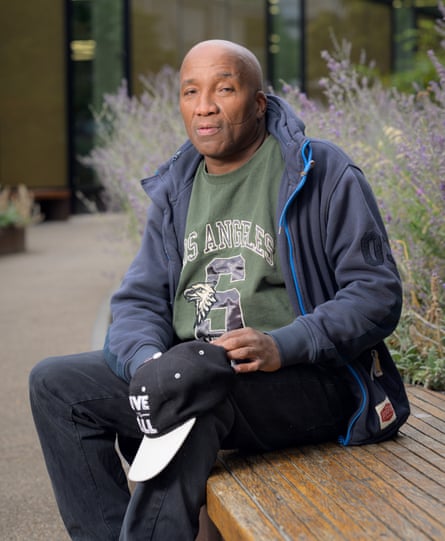
"Tony has a real heart and is a very loyal friend," she says. "He had a rough start in life, and he struggled a bit expressing himself and making people understand him. It had an impact on his self-esteem. He made a mistake; he got caught up with the wrong people and he was sentenced. But he's done the time, paid the penalty, and now he wants to be able to live a normal life, to be able to work. Since coming out of prison his record has been clear; he hasn't done anything wrong in the past 25 years, but they're still holding it against him. He has missed out on all the things that any normal person would do, and has had to depend on family and friends for the basic things to survive. It's ludicrous that he is being kept in this situation."
Hall says he had hoped to get married in 2014, but he was unable to book a ceremony with the town hall because he had no passport or proof of citizenship. "People stay away from me, saying: 'You could be deported next week,'" he says, explaining that it has been hard to build new relationships. His immigration status also means he is eligible for only a restricted form of NHS healthcare offered to homeless Londoners.
The Home Office has a right to deport people who live in the UK permanently but who do not have citizenship, if they have committed a serious offence. However, people who arrived as part of the Windrush generation are usually exempt from removal, under the 1971 Immigration Act. But a Home Office spokesperson indicated that Hall's past offences mean a deportation order remains live, and that he is not eligible for consideration under the Windrush scheme, designed to resolve difficulties experienced by those affected by the scandal. Hall appears to be in a catch-22 situation; he cannot get support from the Windrush scheme because of the deportation order, but he cannot get the deportation order lifted without the support of the Windrush scheme.
His struggle comes at a time when the government has indicated that it wants to amend the 1971 act, to make it easier to deport people even if they have lived here for more than 50 years; this change is fuelled by the home secretary Shabana Mahmood's desire to deport the ringleader of the Rochdale grooming gang, Shabir Ahmed, who arrived from Pakistan as a 14-year-old in 1967. Fiona Bawdon, author of a recent study, "Will I Always Be British?", highlights how immigration status is feeling more precarious for many people whose parents migrated to this country. The 2019 decision to strip the British-born teenager Shamima Begum of her citizenship has left many people whose parents were born abroad wondering whether they, too, are vulnerable to losing their citizenship if they commit an offence. Adrian Berry KC states in the report that there is "a remarkable lack of description" of what behaviour might be enough to trigger loss of citizenship: "It is up to the secretary of state to define what's not acceptable." The state's message to potentially affected communities, he added, is: "Adjust your behaviour and we'll tell you if it's unacceptable."
Hall's solicitor, Naga Kandiah at MTC Solicitors, has called on the Home Office to reconsider his case, due to Hall's status as "a destitute victim of the Home Office scandal". He believes the deportation order was issued in error, because both Hall's parents were Citizens of the United Kingdom and Colonies, and that Hall himself was born as a British Citizen of the UK and Colonies and was granted indefinite leave to remain in the UK when he arrived. Like all Windrush cases, at its heart there is a complex issue centering on the consequences of a UK government decision in the 1960s and 70s to strip people of this status when former colonies became independent. Many were unaware of these complex changes, or that they might then need to apply for citizenship.
"After everything that has been exposed about the Windrush scandal, it is deeply troubling that someone with this history can still be left in such circumstances," says Kandiah. "This is not simply a case about immigration paperwork. It is about a man who has spent five decades of his life in the United Kingdom and has nevertheless been left living in prolonged immigration limbo, effectively destitute and without the security of a home. The question for the authorities is whether the lessons of Windrush are being applied when it matters most."
The Independent Windrush Commissioner, the Rev Clive Foster, who was appointed to act as a voice for people affected by the Windrush scandal, says: "Whatever the legal complexities of an individual case, people should not be left in prolonged uncertainty about their future. When someone is unable to work, access support or rebuild their life while wider issues remain unresolved, the consequences can be severe, resulting in poverty, destitution and homelessness. The lessons of Windrush underline the importance of approaching such cases with humanity, dignity and an appreciation of the practical impact that uncertainty can have on people's lives."
Frustration about still unresolved problems relating to the scandal is spreading. This month the singer Mel B said she was "heartbroken" at the difficulties experienced by those trying to secure justice, after National Audit Office research showed that the Home Office has refused to pay compensation for more than half the claims made by victims of the scandal. At least 53 people have died after applying for compensation, but before receiving a payment. The former Spice Girl joined television presenter Alison Hammond, the former justice secretary David Lammy, Floella Benjamin, Doreen Lawrence and seven MPs, in a call for the government to provide Windrush compensation claimants with funded independent legal support of the kind given to those affected by the Post Office and infected blood scandals. The current system run by the Home Office means the department is "deciding claims for harm caused by its own policies", Foster said.
Hall still has his business cards, printed in purple and green lettering, advertising his still-to-be launched business Always Decorating Services. He would like the Home Office to allow him to start rebuilding his life, and is dismayed that his right to live in the UK continues to be questioned. He is a lifelong Tottenham supporter and likes bacon sandwiches, he says, explaining how rooted he feels in England. "I'm as British as all my mates."