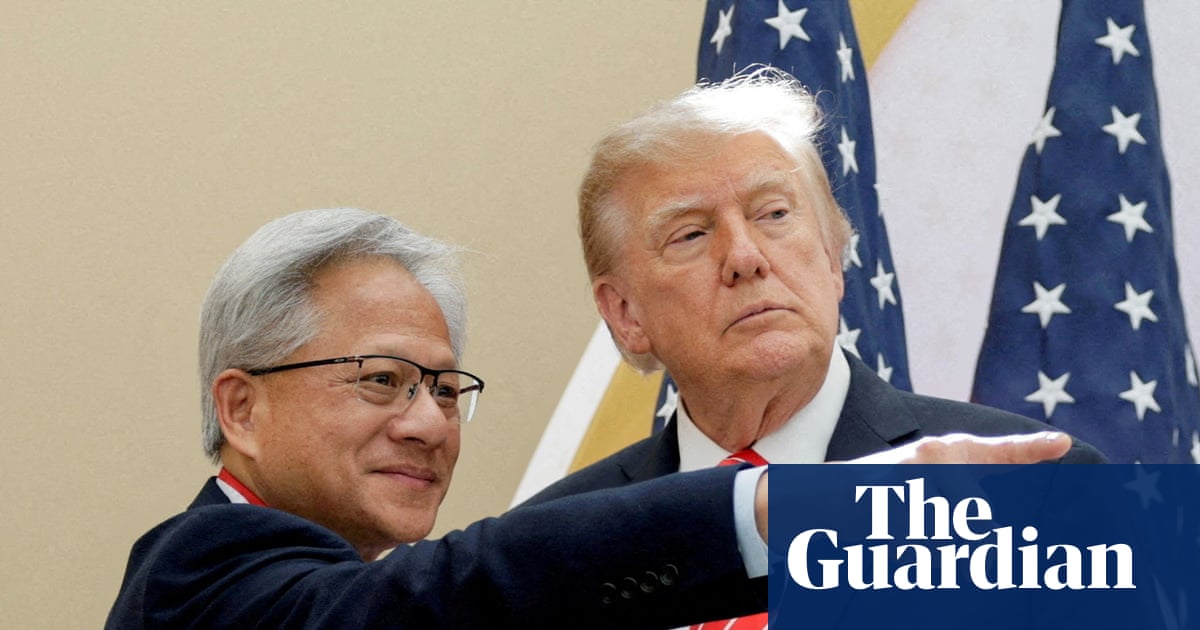
Donald Trump made up to $15m (£11.5m) on his holdings of Nvidia stock after the US chipmaker's share price soared on the surprise return of Jensen Huang as chief executive.
Huang, who co-founded the company in 1993, was ousted by the board after allegations that he had three affairs, including one with a suspected Chinese spy and two with employees. But the Nvidia board reinstated him after an intervention from the US president.
"I spoke to them, let me put it that way," Trump told CNBC on Monday. "And I convinced them … I made the deal."
The US president's financial disclosures to the Office of Government Ethics indicate he might have owned as many as 370,000 shares in Nvidia as of 30 September, the latest available data, in news first reported by the Financial Times.
Nvidia's shares rocketed by 31.5% on Monday, adding about $950bn to the company's value. Huang returned to the company's HQ in Santa Clara, California, receiving a hero's welcome, with crowds of employees chanting "Jensen, Jensen, Jensen!"
Trump has bought Nvidia shares worth between $23m and $86m, according to a BBC review of his government financial disclosures for the past two years. He has also sold some of his stake in the company since returning to the presidency, and gained between $3.5m and $10.2m, according to his government disclosures.
Huang's surprising, and controversial, return to run Nvidia – which is at the heart of the global AI boom – prompted a strong rally in Asia-Pacific stock markets on Tuesday.
Stocks soared in Taiwan, South Korea, Japan, and Australia, as the AI trade lurched back into life after a tumultuous few months. Taiwan's TW50 index leapt by 9.5%, while South Korea's Kospi index jumped by 6.5%, led by the chipmakers SK Hynix and Samsung Electronics. Japan's Nikkei gained almost 4%. Stock markets across Europe were broadly flat.
In the US, stock markets opened down, with the S&P 500 off 0.4% and the tech- heavy Nasdaq down 1.8%. Nvidia's shares fell 6% in early trading. Anthropic, the AI company which sold shares in its record-breaking flotation last week, saw its stock drop by 8.3% at the start of trading, to $80.34, below the $83 IPO price.
.
That followed a rise on Wall Street on Monday. AI shares have been on a rollercoaster in recent months, amid worries over high debt levels in the sector to fund the AI infrastructure buildout, as well as the prospect of tougher regulation in the US after the Democrats' victory in the midterm elections.
Ruben Gallego, a Democrat senator from Arizona, posted on X: "We need to investigate what stock positions took place before the announcement. This White House is the most corrupt in history." He later posted: "Trump may have started the popping of the AI bubble."
Roger Lee, the head of equity strategy at the investment bank Cavendish, said: "Given Nvidia's pivotal role in the AI capex rollout, the implications of Huang's reinstatement could be profound. Borrowing from the [global financial crisis], are some technology CEOs now so systemically important to the future of AI and US leadership in the latest technology revolution that they cannot be fired?
"Questions around the scale of financing required and future monetisation remain, and the dependence on Huang for the future success of AI may paradoxically heighten those concerns especially given Anthropic fell despite yesterday's broad market rally."
Economists said Huang's return meant the US Federal Reserve was more likely to raise interest rates, with the prospect of the AI bubble bursting imminently diminishing.
Jim Reid of Deutsche Bank said: "With fears of an AI slowdown receding, it also led markets to price back in a more hawkish path for the Federal Reserve over the months ahead.
"So for the next meeting in December, markets are once again fully pricing in a 25 basis point hike."