Donald Trump has long embraced vengeance. "I am your retribution," he declared to an admiring audience at the 2023 Conservative Political Action Conference (CPAC) as he commenced his march back to the White House.
It is unlikely Argentina, and far-flung holdovers of the former British empire, were on the US president's mind at the time.
But the tide of international events in the past three and a half years have turned Trump's vindictive mindset to the advantage of Javier Milei, the boisterous rightwing Argentinian president.
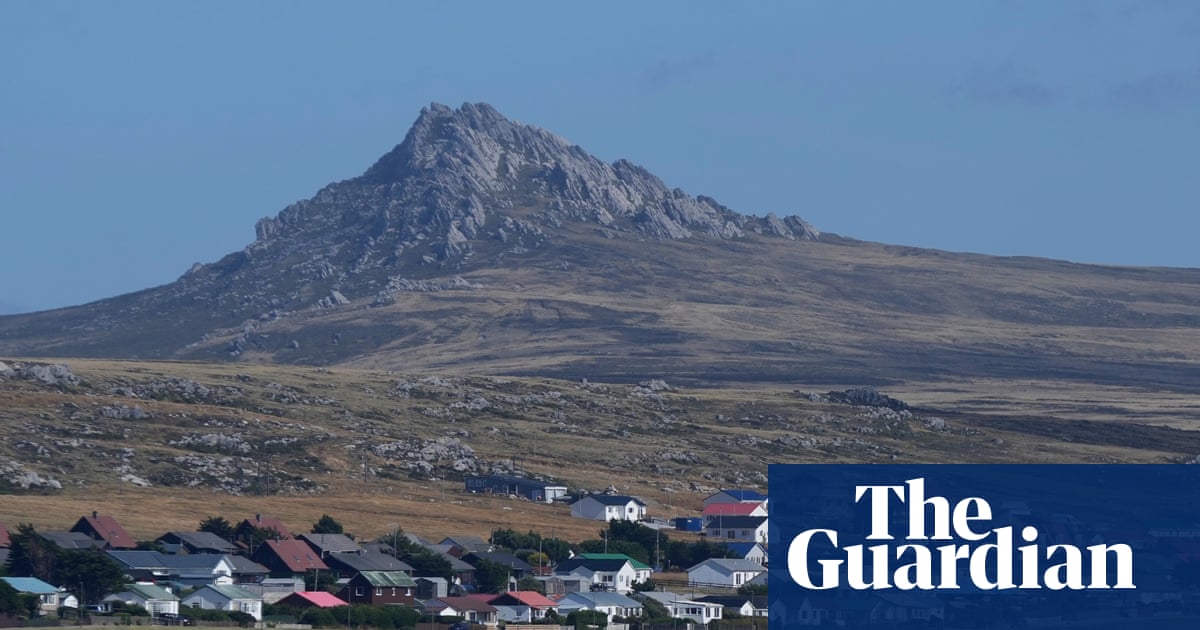
Trump's notorious fixation with payback was almost entirely the trigger for Milei's televised address to his fellow Argentinians on Thursday, as he stated his intention to reopen his country's claim to a set of windswept islands in the south Atlantic – known to Britain as the Falklands, and to Argentina as the Malvinas.
The centuries-old dispute over the islands' sovereignty has lain dormant since 1982, when the two countries fought a brief, but bloody, conflict that began after Argentina's ruling military dictatorship invaded the territory.
Britain reclaimed them after troops in a naval taskforce dispatched by the then prime minister, Margaret Thatcher – ironically lionized by Milei as a political exemplar and inspiration – stormed the territory and eventually forced Argentina's surrender.
An uneasy peace has reined in the generation since, although Argentina, which returned to democracy the year after the conflict, has never renounced its claim to the isles – despite the adamant insistence of their less than 2,000 inhabitants that they remain British.
This week, however, Trump suggested he is reconsidering US support for Britain's sovereignty over the Falkland Islands. Why would the president go out on a limb to threaten this fragile peace? And why now?
Milei jumped on Trump's comment that he was "reviewing" the US's longstanding neutral stance on the territory's sovereignty, which amounts to a de facto recognition of Britain's control.
Fueling Trump's animus is grievance that Britain, under former prime minister Keir Starmer, declined to support the US president's decision to go to war on Iran, another irony given that country's deep-rooted suspicions of Britain and its imperial past.
The president's obsession that allies declined to help him in a war he never consulted them on runs deep and wide – from Westminster to Seoul – and has the potential to upend US relationships around the globe, if unchecked.
And Milei's attempt to capitalize on Trump's vengeance underlines the potential for ripple effects of this war to reach waters far beyond the Gulf.
In what has become a repetitive refrain, Trump laid bare his sense of wounded affront in an interview with a rightwing British cable channel on Thursday.
"Your country was not there to help me," he told GB News. "We didn't need help, but I did ask Nato, and I asked your former leader, 'Why don't you send a couple of ships?' He said, 'We don't have any.' It was pretty sad, the whole thing."
Milei's opportunism could also be used by Trump as a bargaining chip – to lever more money from the cash-strapped UK treasury for defense spending and Nato contributions, after the new British chancellor of the exchequer, John Healey, recently suggested that it might not reach increased spending targets.
It is a sorry pass for the "special relationship", fostered through alliances in two worlds wars and deepened during the cold war and subsequent conflicts. Yet Britain is hardly alone in feeling the heat of a wrathful Trump.
Vengeance has been targeted in recent months at numerous other allies, now regarded with more hostility by the White House than traditional adversaries such as Russia and China.
Annual joint military exercises with South Korea – a vital ally of Washington since the Korean war broke out in 1950 – were suddenly scaled down and cut short by six days last month, on Trump's orders, because of his irritation that the Seoul government declined to join the fight against Iran.
He has repeatedly threatened to bomb or "blow up" the tiny Gulf kingdom of Oman, which has had friendly ties with the US for 200 years, if it impedes his efforts to reopen the strait of Hormuz, which Iran has closed to most commercial shipping.
The White House also announced the withdrawal of 5,000 US troops from Germany after the country's chancellor, Friedrich Merz, rebuffed pressure to get involved in the Iran conflict and said Trump had been "humiliated" in the conflict.
Threats of retribution have also been aimed at Spain, which has resisted pressure to boost defense spending, and Italy, whose prime minister, Giorgia Meloni, was a former Trump ally.
Turbulence under Trump
But Milei, a self-styled "anarcho-capitalist" who has paraded with a chainsaw to signify his attitude to public spending and attended Trump's 2025 inauguration, remains on the US president's good side.
Last year, the administration extended his troubled government a $20bn loan guarantee to stabilize the infamously shaky Argentinian economy – but premised the money on Milei's party defeating the leftist opposition in forthcoming congressional elections, which it duly did.
This time there are no guarantees, other than that of never-ending turbulence at the hands of Trump. Such rough currents may be the "winds of change" Milei referenced in Thursday's speech, delivered – Trump-style – with his cabinet members flanking him.
But he may have been aware the phrase had other, historical connotations – evoking the words of a famous speech in 1960 by then British prime minister Harold Macmillan in Cape Town, heralding independence for Britain's former colonial possession in Africa.
"The wind of change is blowing through this continent," Macmillan said then. "Whether we like it or not, this growth of national consciousness is a political fact."
In his address, Milei suggested the sun was setting on Britain, just as it once did on its empire, citing multiple crises of a migratory, demographic and economic nature that are unlikely to be resolved. "It is clear that they are on a path of decline," he pronounced.
He did not mention his own falling political popularity – a factor which may also have played a key role in the former military junta's decision to seize the islands in 1982, as opposition grew against the backdrop of mass disappearances of political dissidents and multiple human rights abuses.
Then, too, Britain was grappling with tensions over immigration and race riots, soaring unemployment and long-term economic decline that Thatcher had been elected pledging to reverse. In the late winter of 1982, there was little sign that she was capable of doing so – until the Falklands conflict sparked a sudden upturn in her political fortunes.
But she had the solid backing of the special relationship, and her ideological soulmate, Ronald Reagan, in the White House. Andy Burnham, Britain's newly installed Labour prime minister, must contend with the chill wind emanating from the menacing and destabilizing presence of Trump.