
Veterans who say they lost out on tens of thousands of pounds under an "unfair" compensation scheme for those affected by the military's LGBT ban have won the first stage of a legal battle.
The ban between 1967 and 2000 meant those who were, or thought to be, gay or transgender were subjected to interrogation and dismissal.
Steven Stewart and Mark Shephard were "forced to resign" and so were eligible for the LGBT Financial Recognition Scheme. They received £7,000 and £5,000 respectively but claims for larger sums were refused as they were not formally dismissed or discharged.
On Wednesday, Mrs Justice Eady ruled at the High Court they could take their claim against the MoD to a full hearing.
More from Somerset
Amanda Jones, representing the MoD, said the claim was "not arguable", adding the scheme had a "limited total budget" and was set up to "mark and alleviate harm", but did not concede any legal liability.
The compensation scheme, set up by the MoD in 2024, offers two payments: a flat-rate payment of £50,000 for those who were dismissed or administratively discharged under the ban, and "impact payments" of up to £20,000 for those affected by it.
Isabelle Agerbak, representing Stewart and Shephard, said this meant those who were dismissed were eligible for a total of £70,000, whereas those who resigned after an ultimatum are only eligible for a maximum of £20,000.
Departure was 'devastating'
The court was told Stewart, from the south west, had served as a corporal in the Royal Military Police from 1988 until 1995, when he was "stripped of his duty pistol and escorted into the office of his commander" and told "incriminating letters" had been found.
Stewart was interviewed under caution and resigned after being told he would face a court martial and potential prison sentence.
"Leaving under those circumstances was devastating," Stewart said.
"My military career ended overnight. The impact of that decision has stayed with me ever since.
"I rebuilt my life, but what happened has stayed with me for nearly three decades.
"It affected my confidence, my relationships and how I saw myself."
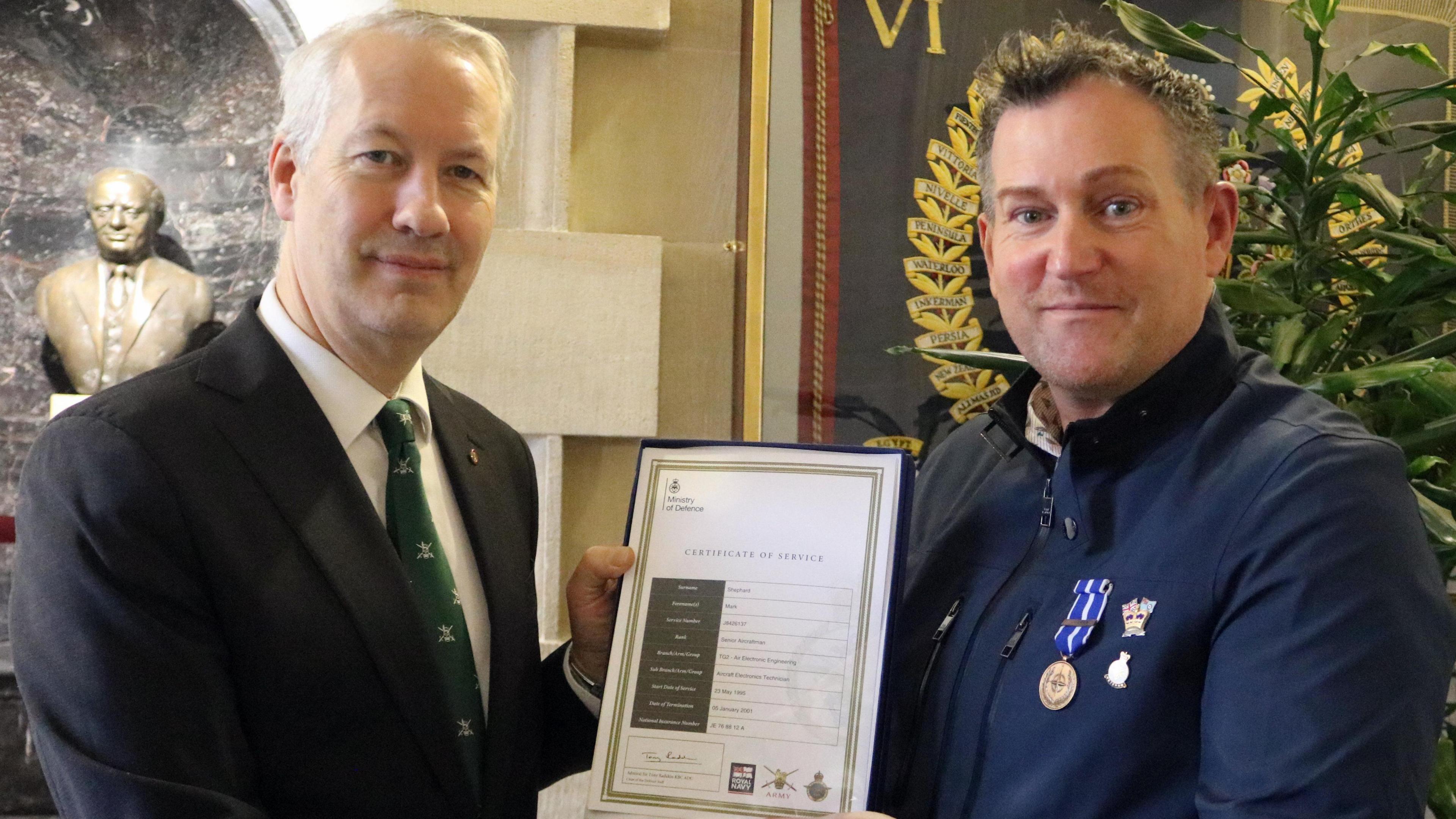
Shephard, from Taunton in Somerset, served in the Royal Air Force (RAF) from 1995 as a senior aircraftman technician.
In 1999 he broke down in front of his commanding officer after persistent bullying and told her he was gay, as he was unaware of the ban at the time.
He later applied to leave the RAF after being told he would otherwise be summarily dismissed.
Shephard said he was "driven out of the career I trained hard to achieve and excelled at" and had only recently told his friends and family the real reason he left the RAF.
He received an official apology in 2024 as part of a programme of restorative measures for those affected by the ban, which was presented by Taunton MP Gideon Amos.
In written submissions, Agerbak said the scheme was "irrational and unfair".
She said: "It is entirely unclear how and why the defendant arrived at an outcome whereby those who were compelled to resign would be eligible for tens of thousands of pounds less than those with similar experiences, but who were dismissed or discharged."
Jones, for the MoD, said £75m had been spent on the scheme and that making it available to those who were forced to resign would result in "a very significant additional sum".
She said there had been benefits for the claimants of resigning rather than being dismissed, including being given a positive employment reference and not having to repay a £4,000 bonus.
Get in touch
Follow BBC Somerset on Facebook and X. Send your story ideas to us on email or via WhatsApp on 0800 313 4630.