In his remarks, Bessent says that today, at President Trump's direction, the United States Treasury "has begun Operation Economic Outcast" which he described as an "unprecedented campaign" against Iran "and its enablers."
"We are launching an economic onslaught against Iran's financial connections around the globe" he said. "Our objective is to sever every economic lifeline that sustains this tyrannical regime until Tehran stands alone."
When asked why the US treasury department is not implementing sanctions immediately, Bessent said that it was to give nations who conduct business with Iran the "opportunity to remedy bad behavior".
"Why would I want to blow up the global financial system?" he said. "We believe that it's important to level set and give people a cure period. But they should know that will move very quickly, and that we are serious."
Notably, during his press conference today, Scott Bessent didn't specify which countries would be targeted by secondary sanctions, even when asked by reporters whether China – the largest importer of Iranian oil – would be impacted.
While Bessent said that "quiet diplomacy" is the best way to engage with countries who still maintain trade relationships with Iran, this latest move is an attempt to show that "no one is above" sanctions.
"We know who they are, they know who they are, so when the hammer of US treasury actions falls upon them they will have no one to blame but themselves," Bessent said.
He described the new wave of sanctions as "economic asphyxiation" of the Iranian regime and "no one should test our resolve".
The treasury secretary also said he would not "name names" about the world leaders that Donald Trump is in touch with when it comes to ending business with Iran.
Bessent also added: "I'm not going to set timelines, but we do not have infinite patience here."
Bessent said that the sanctions will target "five of Iran's most vital lifelines that it exploits in other countries – digital assets, technology, gold, aviation and shipping."
"As I speak, Treasury's Office of Foreign Assets Control is also sanctioning over 60 entities, individuals and vessels around the world that enable the Iranian regime to procure illicit nuclear and missile technology, conduct cyber operations, and generate oil revenue," he said.
Bessent says that Iran faces two choices, "complete global isolation and a subsistence economy or a path back to normalcy with an opportunity to rejoin the global economy".
"Treasury has mapped every node, every facilitator, and every network that Iran has used to smuggle oil and evade sanctions," he added. "Beginning today, the actions of treasury and other agencies will tighten the noose and block every potential source of revenue that funds the IRGC (Iranian Revolutionary Guard Corps) and the evil Iranian regime."
Later in his remarks, he warned: "Those who stand with the United States will reap the rewards of our partnership. Those who tether themselves to the Iranian regime should expect to share in the isolation of a withering regime."
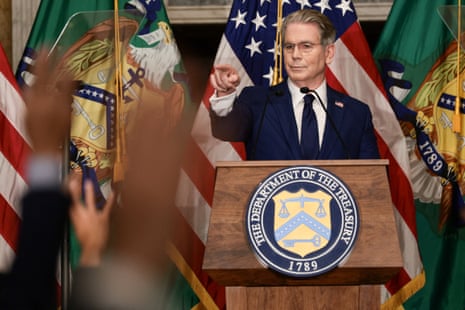
In his remarks, Bessent says that today, at President Trump's direction, the United States Treasury "has begun Operation Economic Outcast" which he described as an "unprecedented campaign" against Iran "and its enablers."
"We are launching an economic onslaught against Iran's financial connections around the globe" he said. "Our objective is to sever every economic lifeline that sustains this tyrannical regime until Tehran stands alone."
Scott Bessent, the US Treasury secretary, is now delivering a press conference.
It comes a day after he wrote an Opinion Piece for the Financial Times, in which he warned that an "economic D-day is coming for Iran".
During his remarks today at a manufacturing facility in Brewer, Maine, Vice President JD Vance referred to Canada "a state" before noting "sorry, Freudian slip" as the audience laughed.
Vance went on to critique Canada, saying that it is a "country that has underinvested in its military that quite literally would get invaded by a foreign country, were it not for the umbrella of protection provided by the United States of America".
Since Trump's return to the White House last year, Trump has discussed making Canada the US's 51st state, which has enraged many Canadians. A petition to expel the US ambassador to Canada, accusing him of normalizing the notion of the US annexing Canada, has collected about 248,000 signatures.
In a new post on Truth Social, President Donald Trump is accusing Democrats of putting out "fake polls" as "demoralization operations".
"They're putting them out at levels never seen before" Trump claimed, without providing evidence to back up his allegation. "They're called 'Demoralization Operations' where they try to demoralize Republicans so that they don't go out and vote."
In the same post, he also claimed that "the actual Polls are tremendous, and the Spirit in our Country has never been higher."
Vice-president JD Vance is speaking at a defense technology manufacturing facility in Brewer, Maine at the moment. As I noted earlier, – the Republican senator from Maine who is facing a competitive re-election race this year and criticized the faltered trade talks between the US and Canada, is not appearing alongside Vance today, with her campaign telling local media that she had a clashing commitment.
"Whenever I'm in Maine, I've got to give Susan a little bit of crap," Vance said on stage today. "As you know Susan is the most independent member of the United States Senate, and as the president of the United States Senate she sometimes makes my job just a little bit harder."
He added: "But she makes it harder, because she's coming to work every day and fighting not for a political party or not for any abstraction. She comes to work every single day and fights for the great people of Maine … she tries to get as much good for this state out of Washington, and as little bad out of Washington for this state. Which, by the way, is a very hard job."
Collins, who will face former state lawmaker in November, is contending with a spike of anti-Trump animus going into the midterm elections. Democrats have sought to categorize her so-called "independence" and "moderation" as weak checks on the president's agenda, often mocking her "concerns" about Trump's hardline policies.
In an interview with CNBC ahead of Donald Trump announcing his latest threat to implement 50% tariffs on Canadian cars and auto parts, , the US trade representative, said that Canada is ultimately responsible for the collapsed talks over the weekend to reach a deal on the duties between the two countries and longtime allies.
"We set about to finalize it, and then in the last hours, I think there were things that the Canadians just – you know, they wanted more," Greer said today. "I don't know if it was political for them. It certainly doesn't make economic sense, but perhaps for political reasons … they wanted more and we weren't prepared to do that."
Following Donald Trump's announcement that there would be a temporary pause on tariffs to allow for more than 300,000 metric tons of foreign beef to be imported to the US, a number of Republicans have pushed back on the latest trade policy – arguing that it stands to negatively impact American ranchers who are already feeling the burden of higher costs.
The president has said the move, announced on Friday, would "reduce prices for Americans while giving space for our Great American Beef Herd to grow again", however, several GOP lawmakers claim this is a short-term fix for a chronic problem, namely a 75-year low in US cattle supply.
"I absolutely want to see those prices come down," said Congresswoman , the Republican nominee in a competitive US Senate race in Iowa. "But I think this isn't the way to do that."
In an interview with Fox News on Sunday, Hinson added: "I think we need to focus on letting our cattle men grow their herd … it takes some time and it takes some resources, and so I think we should be letting market conditions to do what they do – demand for beef is still really high."
Other Republicans in states with sizeable cattle farming industries also criticized the president's recent decision. "Short term policy shifts do not equal long term solutions," said , a GOP Senator from Nebraska and frequent ally of the Trump. "Flooding the market with lower quality beef compromises Nebraska farmers and ranchers. They should be enabled to grow herd sizes and meet consumer demand."
Another Trump loyalist, Senator of Montana, said that while the president's "heart is in the right place on wanting lower prices for the American people", the action would actually make it more difficult for American ranchers to rebuild their herd.
Aside from beef, other Republicans criticized the Trump administration's ongoing trade war with Canada over the weekend. Senator , a Republican from Maine who is facing a re-election battle this year, called the "on-again/off-again" trade talks between the US and Canada would lead to "higher costs, risk, and uncertainty" for businesses in Maine – which borders Canada.
"Ever since the tariffs were first announced, I have heard from many businesses, farmers, and lobstermen concerned about the cost of navigating the tariffs, the lack of domestic supply chains, and the likely imposition of retaliatory tariffs by Canada," Collins said in a statement after trade talks broke down over the weekend, urging "both sides to return to the negotiating table".
A reminder that the current tariff on Canadian automobiles and parts sits at 25%.
After the trade talks with the US collapsed over the weekend, Mark Carney vowed "dollar for dollar" retaliation on the initial round of 50% tariffs that went into force on Saturday.
"You're at war when you're attacked, and we got attacked," the Canadian prime minister told reporters in Ottawa. "We cannot accept what they've offered and we will not give what they've asked."
Earlier, Carney said that "last-minute changes in the US proposed terms were unfair, uneconomic and called into question the reliability of any deal", and ultimately led to collapse in talks.