Merz begins by saying "we are all deeply shocked" by the result in Saxony-Anchalt.
"We did not expect it to turn out this way," he says.
He says the vote "will have repercussions" and says even a glance at who congratulated the AfD shows "the level of international attention this result has garnered."
He says that "when nearly 60% of voters … cast their ballots for political parties that fundamentally call into question our country's democratic institutions … it is an election result we cannot simply move past as if nothing happened."
He concedes this is "the most severe election defeat the CDU has suffered in years, indeed in decades."
A little more of European Commission president Ursula von der Leyen's words in earlier here:
Greenland can count on the EU. Territorial integrity sovereignty, the inviolability of borders, these are fundamental principles of international law. We want to be very clear and repeat again here that Greenland's future is for the people of Greenland and Denmark to decide, no one else.
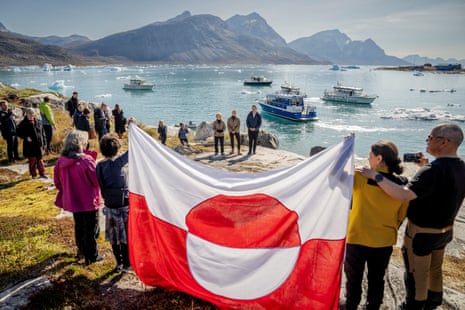
Meanwhile, EU's Ursula von der Leyen, Greenland's PM Jens-Frederik Nielsen and Denmark's PM Mette Frederiksen are speaking in Nuuk, Greenland.
Their press conference is part of von der Leyen's landmark visit to Greenland, during which she pledged €200m to invest in projects there focusing on energy, raw materials and connectivity there, AFP reported.
The new EU-Greenland Partnership Package is meant to strengthen the territory's ties with the EU amid continuing interest from the US president, Donald Trump.
In a pointed remark, von der Leyen said the bloc "stands in full solidarity with Denmark and Greenland," and Greenland's future is only for the people of Greenland to decide.
You can follow their comments here:
ends the presser with another defence of his time in the government, and saying he needs to get better at explaining his rationale and reforms to the public.
He concedes there is a problem, and he needs to address it.
And that's where the press conference ends.
Merz also gets asked about Germany's position on Russia and Ukraine given the high support for pro-Russian parties in Saxony-Anhalt.
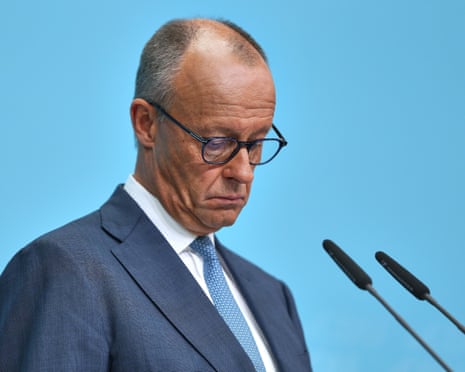
He says it was 57.7% of the vote last night.
He says resolutely that he will "not deviate by even a millimeter from my fundamental conviction that we must defend our freedom, especially now, from Russia."
"I will likely have to explain this much more frequently and much more intensively," he concedes.
But he says the threat to Germany's internal security "is not abstract; it is very concrete" and that "if we stop supporting Ukraine, things will not get better, but worse."
"The goal of the Russian leadership is to destabilise the value system of what we used to call the West. And that value system is not up for negotiation."
Merz gets asked about the concerns reported among some minorities in Saxony-Anhalt about what could happen if AfD came to power.
The Guardian's covered that extensively before the vote.
He says that all state governments have to abide by the constitution.
"That holds true today, and will hold true tomorrow."
In a more direct question, Merz gets asked at what point he would be prepared to accept his approach is failing and conclude that he can no longer serve as the chancellor.
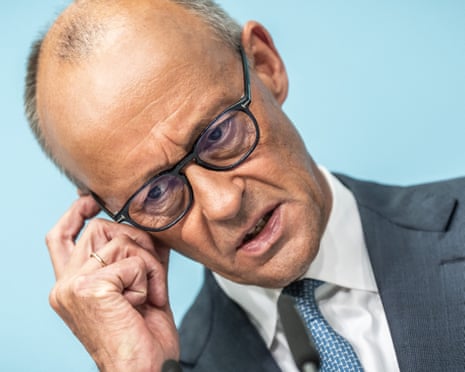
Could the two other upcoming state elections be his breaking point?
He says he is "thinking hard how we can find our way back to shared political success."
He says he is "not the sort of person that wears their emotions on their sleeve every day," but "giving up is not an option."
Merz also gets asked about apparent differences of opinion within the coalition government with the SPD.
He says "we need to talk" between partners, but lists what he focuses on what he says are some of this government's success stories.
He says more needs to be done to remove obstacles to competitiveness and reduce bureaucracy.
Saxony-Anhalt's Schulze gets asked if he can see some CDU politicians defecting to AfD to give the party a majority in the state parliament.
He says the AfD previously said it would not want to talk to other parties. But he says he cannot see any members of the CDU faction leaving to join AfD.
Merz also broadly defends his government's track record.
He says the government will need to "demonstrate that the path we chose last year … is the right one" to regain public trust.
Merz also gets asked about his personal responsibility for allowing the AfD to gain in strength.
He points to both international trends, and domestic reasons.
He says "reassessing this situation" is needed to respond to this crisis.
But he says any democratic government relies on compromises, and "perhaps we need to emphasise, explain, that point more."
He says he "has been reflecting" on these issues for some time, but does not elaborate as to what he is actually planning to do about it - for now.
In further comments, Merz comes fairly close to drawing a link betweeen AfD and Russia, as he says "2,500 kilometres in the east, the election results were being celebrated."
"That comes as no surprise, given who tried to foster and bring about this outcome. In that sense, we know exactly who we are dealing with here."
Saxony-Anhalt's outgoing premier Sven Schulze concedes the vote and says the party "no longer has a mandate to govern" and will be in the opposition.
"The mandate to govern now lies with the AfD," he says.
He says the decisions on what's next lie down with the elected members.
Merz says he wants to focus on this in the coming days and weeks, and says he is aware of "our shared responsibility for our country."
"I am aware of my personal responsibility for our country. I am determined to live up to this responsibility," he says, seemingly dismissing any talk he could choose to step down from the post.
Merz says Germany needs "fundamental reforms" in response to the result, a challenge he says he is ready to face.
"It is a matter of nothing less than the future of our country and the opportunities available to our children and grandchildren – opportunities we must not squander," he says.
He says the government needs to get better at explaining its actions and rationale behind them.
Merz says it is "the very essence of democracy" that people's attitudes shift, but he says "there is one thing that is not up for a vote: the rules by which we live together and the values enshrined" in the constitution.
He says Germany "bears a special responsibility due to its history," and will "always uphold our political order."
Merz begins by saying "we are all deeply shocked" by the result in Saxony-Anchalt.
"We did not expect it to turn out this way," he says.
He says the vote "will have repercussions" and says even a glance at who congratulated the AfD shows "the level of international attention this result has garnered."
He says that "when nearly 60% of voters … cast their ballots for political parties that fundamentally call into question our country's democratic institutions … it is an election result we cannot simply move past as if nothing happened."
He concedes this is "the most severe election defeat the CDU has suffered in years, indeed in decades."
is speaking now.
I will bring you the key lines.
Mainstream politicians around Europe have expressed alarm after the far-right Alternative für Deutschland (AfD) swept to a historic state election victory in Germany, while nationalist figures cheered the result as a mandate for change.
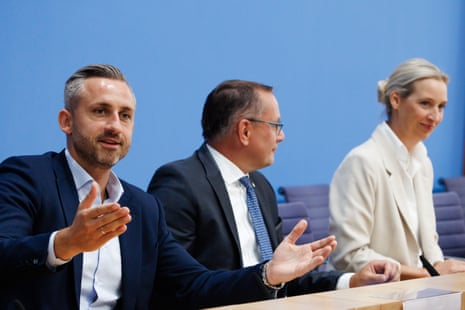
While falling just short of an absolute majority, the AfD surged into first place in the Saxony-Anhalt state election on Sunday, exit polls showed, putting the far right within reach of power at the state level for the first time since the second world war.
Back to Germany, we are expecting to hear from chancellor Friedrich Merz in the next half hour.
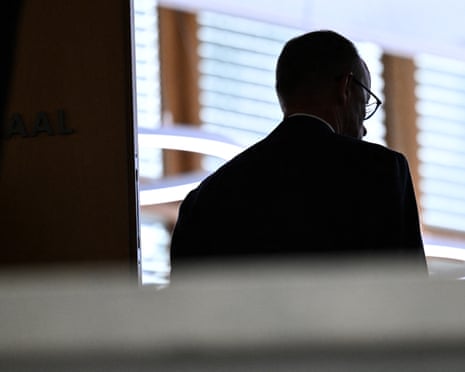
As reported earlier (11:22), he chaired a crisis meeting with his CDU colleagues this morning, and Bild reported that he said the AfD's win in Saxony-Anhalt had shaken his CDU party to its core and signalled that a major reckoning was needed.
"This shakes our party to its very foundations. We cannot simply carry on as before, nor can I, nor can the federal government," Merz said, according to the newspaper.
Let's see what he says in his first public comments since the election soon.
I will bring you his comments here live, obviously.
The funeral service has just concluded with the church bells marking the occasion, as can be heard on Tanjug news agency's live stream, which shows thousands of Mladić's supporters gathered in the area.
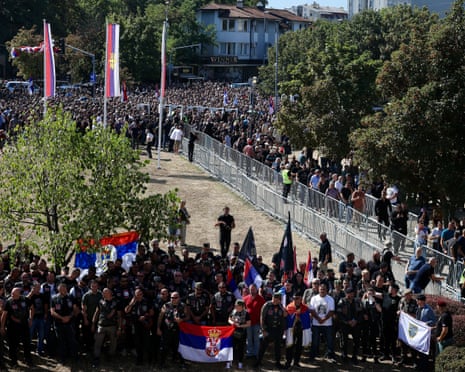
Mladić is expected to be buried at a cemetery nearby in the next hour or so.