Melbourne architect Chris Gilbert had run out of eggs. He texted a neighbour and within minutes, he says, their child arrived with some. "Then I made brownies and my kids took some over to the neighbours' house."
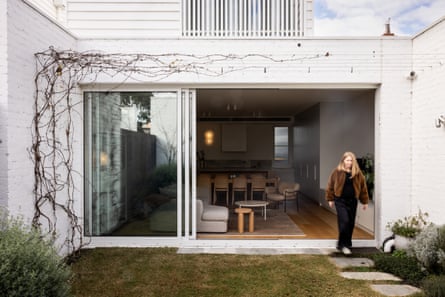
It sounds like a flashback to a bygone era, but this neighbourly exchange took place this month, at the Davison Collaborative, a novel housing project in the Melbourne suburb of Brunswick. In 2020 the townhouse development replaced one past-its-prime brick veneer house with three architecturally designed three-bedroom family dwellings, trebling the lot's density and future proofing it "for at least the next 50 years," says Liam Wallis, from the sustainability focused property development and consultancy company Hip V. Hype.
In 2018, times weren't so idyllic. Gilbert was bring outbid at auctions week after week. Each Monday he'd arrive despondent at his shared working space with Wallis, and Wallis' business partner Peter Steele.
Wallis had already been mulling whether pooling resources to redevelop single home lots into multiple dwellings could increase density, while saving families money.
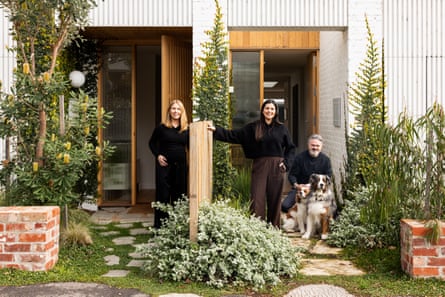
"I said 'hang on a minute, let's just do a project. Let's see if this works. Let's figure out how hard it is,'" Wallis says.
The collaborative eventually bought a postwar home, owned by the same family for 50 years, at auction. The parents had died and their children were selling. Two years later, the three couples moved in. "And each of those homes were the same size as the original dwelling," Wallis says.
As Wallis, Gilbert and Steele were moving in, a similar plan was unfolding in another inner-north Melbourne suburb. During lockdowns, a close-knit group of friends and colleagues (with experience in architecture, interior design, project management and a tradie among them) who lived within walking distance of one another in Carlton North, were spitballing ways to parlay their collective professional wisdom (and their finances) into a similar proposition.
Four years later, Sarah Birthisel and her husband, along with couples Sarah Cosentino and Stephen McGarry, and Tanya Smith and Neil Clarke, moved into their tri-townhouse venture, Northcote Townhouses.
Sitting down with Birthisel and Cosentino, the pair are obviously pleased with how things turned out. Knowing such an endeavour wouldn't be feasible in Carlton North, the group looked to the adjacent municipality of Darebin. Fewer heritage overlays, larger lots and cheaper prices, they explain, made the area far more suitable.
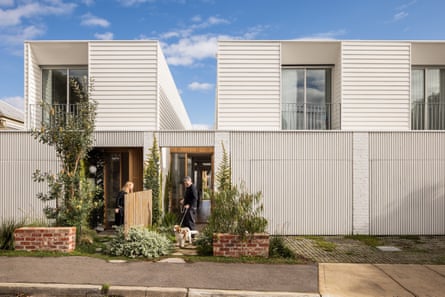
After agreeing on their vision and drafting contracts, the consortium bought a 638 sq metre property that backs on to the Mernda train line in Northcote. Their first order of business was to make their intentions known to other residents on the street. "It was really important to us to connect with our neighbours, to make them aware that this wasn't going to be something that we would be flipping … That this would be our home, and that resonated really well with the community," Cosentino says.
Then they went to the council with a strategy that Birthisel says was "very sympathetic to the streetscape and continued the rhythm of the streets". Development approvals went smoothly and they broke ground in 2022. When it came time to move in, they staggered that process so each couple had some time to settle in.
Cosentino and Birthisel say that while the communal aspects of the arrangement were alluring, each family also wanted a sense of privacy. Two years into their experiment, they feel as if they've achieved that.
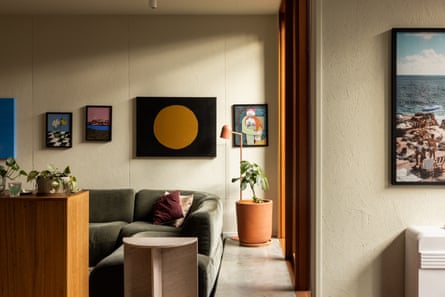
"I love the security of knowing I've got friends at my doorstep. I also equally love that sense of retreat and sanctuary; we could be in the house the whole weekend and feel like we're not around everyone else at all," Cosentino says. On the flip side, last summer, they say, was full of plenty of balmy evenings where private gatherings with family and friends spilled into common areas, and impromptu alfresco meals were shared, with their children playing in the communal garden. "Those incidental interactions are so beautiful and bring such a buzz."
These two projects have been nominated for a slew of awards – the Davison Collaborative was a finalist for the Victorian premier's design awards, while Northcote Townhouses received a commendation in the Houses awards. While they underline how collectives with the right professional and financial capital can leverage their resources into remarkable housing solutions, they were no small undertaking.
"It's very difficult for just anyone to do it, unfortunately," Wallis says. Their project was stalled at planning, and then at the Victorian civil and administrative tribunal (Vcat), for a year. And, like the Northcote venture, the professional experience of the members made all the difference.
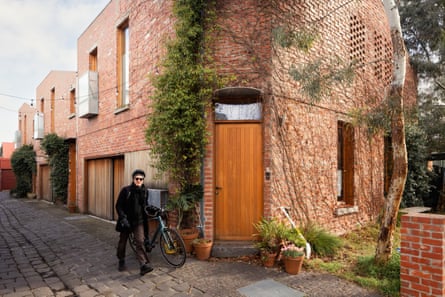
In an effort to keep friendships intact, the Davison Collaborative deferred broad spectrum project management to Hip V. Hype because "it's impossible to run a complex project if you have to go back to someone with every decision, but there are select, important decisions that need collective agreement and so we carved those out [early on]," Wallis says.
For less prepared consortiums, Tim Riley is in the business of filling knowledge gaps. His company Property Collectives has worked on 11 collaborative housing projects around Melbourne and charges a fixed management fee to guide groups of families, friends and occasionally strangers through the process of property development, right through to final fixtures.
He says the kind of people who use his service "aren't seeing the sort of homes on the market that they would want to live in, at a price point that makes sense to them".

"There's an acknowledgment that if we want to create this little co-housing community of 10 or 20 households, we need to do it ourselves."
While participants often save upwards of $100,000 compared with buying a similar home in a similar area, Riley says these homes are not "capital-A affordable". But beyond design and financial imperatives, he believes there is something deeper at play.
"I think it is all rooted in a belief that having more meaningful social connections with your neighbours is a really valuable thing to have in life," Riley says.
"For the young families that are involved, the desire to have a place where their kids are growing up in a supportive community with a range of people in different life stages is really attractive. And similarly for the older generation, they're not wanting to go to a retirement village, they're wanting an intergenerational community."
Riley says his company keeps contracts as standard as possible "so that lenders, builders and the whole ecosystem doesn't see it as being terribly strange".
On an interpersonal level, Riley thinks consortiums are most successful when participants share a clear vision. Typically they employ "sociocracy", which establishes from the outset which decisions need to be unanimous and which require majority approval. Each household has one vote. "And that can reduce a lot of friction through the process."
The company then walks all participants through a plan of work that has seven decision gates, starting with strategic vision and ending up in operations. He says that "chunking" the herculean task makes the process less daunting. The process from forming the group to moving in takes on average four years.
While no longer a resident of the Brunswick project, Wallis believes every block on Davison Street could easily accommodate similar ventures, turning nine homes into 27.
"We did a bit of an exercise and looked at, within a kilometre radius, how many blocks of land were on laneways in Brunswick with the same attributes as our site. There was something like 500. We could turn 500 family homes into 1,500.
"We don't need to build 20-level buildings to increase density. We just need to use what we have more effectively."