he new series of Time is not an easy watch. The opening seconds of Jimmy McGovern's prison drama show a normal woman on a normal bus, as it drives up a normal road. But to the right of that road is a huge concrete wall, topped with barbed wire and CCTV cameras.
The wall is only partly visible, just as prisons themselves tend to occupy a space towards the very edges of our thoughts. They exist, but not as part of normal life. But McGovern's drama shows just how permeable that wall is.
The show's fictional young offender institution, HMYOI Alderwick, is a place that boils with anger. As new arrivals enter the prison, an officer tells them: "Keep going, ignore the noise." As if you ever could. The sound of prisoners shouting and kicking their cell doors is an assault on the ears. Those scenes are louder than any headline, of which there are plenty these days; overcrowding, escapes from custody, the latest early-release scheme. What McGovern does is crank the volume so loud it's impossible to block out.
The reality is that prisons are closer to us than they might seem. The Sentencing Act 2026 allows prisoners serving standard determinate sentences to be released after serving only a third of their sentence in custody. The early-release scheme is intended to help relieve the prison capacity crisis, but as the recent recall rate demonstrates, this solution is temporary.
Many of the boys in Time would not be eligible for early release. Murder, manslaughter and rape are among the stated exemptions. But the value of time in prison is not only determined by its length, but by how it is spent. Just as David Tennant's character bemoans the lack of training or education for young men in custody, so do prison staff across the country. They know what is blindingly obvious: angry people don't come out of prison less angry if they've been banged up for 23 hours a day.
Life inside Alderwick demonstrates the futility of keeping people locked up for hours on end, isolated from one another and with nothing to do. The culture of "keep-aparts" is firmly entrenched in many English prisons, particularly those housing young adults. "Keep aparts" are as they sound; groups of prisoners who are quite literally kept apart, often due to gang issues or postcode wars. Prisoners known to have conflict with others end up with a long list of "keep-aparts" on their file. They must associate separately from their "keep aparts" – they cannot attend the gym, education or visits with anyone on that list. This results in staggered regimes that are increasingly complex to manage. Rather than everyone having three or four hours out a day, each group only has one hour.
Short-term, this works. But in the long-term, this stifling conflict-management tactic only exacerbates division and violence.
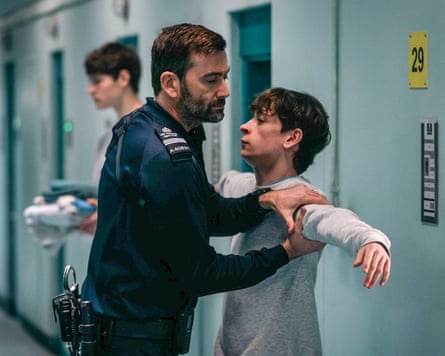
In Time, an officer suggests a solution to this issue – perhaps all new entrants could be told that, from now on, they would have to associate with everyone living in their unit. No more "keep aparts". The governor's response is: "We'll park that one for now." But that's the problem. We are parking it and never coming back. We are releasing people from prison but not addressing the issues that put them there in the first place. Letting people out early was inevitable; prisons are full. But when 80% of all offending in England and Wales is reoffending, it suggests only a small minority come out changed for the better.
Most institutions are depressingly similar to Alderwick: no education, no libraries, with prisoners barely allowed any time out of their cells at all. A report this year on children in custody found that, at almost every establishment in the youth custody estate, prisoners were locked behind their doors for as long as 19 hours a day. The overstretched, understaffed system does not allow for integration, socialisation, healthy forms of argument and discussion, or opportunities for conflict resolution. If it did, perhaps early release might not feel like such a bad thing.
Being banished to a place characterised by violence and being locked up may seem an appropriate punishment for criminals. But on release day, the only ones being punished are us. Because those angry boys who fight and kick and slash, the ones with the baby faces and sprinkling of acne, are the same boys who grow into men behind that imposing wall. They are the same boys who board that normal bus on that normal road, right next to you and I.
This series of Time is beautiful and ugly and exact, all at once. The least realistic bit is the surplus of toilet roll in one boy's cell. There's never enough toilet roll inside. But the major flaw of the show is that it only lasts three episodes. Because the boys represented in those fictionalised prisons are still banged up in the real ones, while the rest of us ignore the noise.