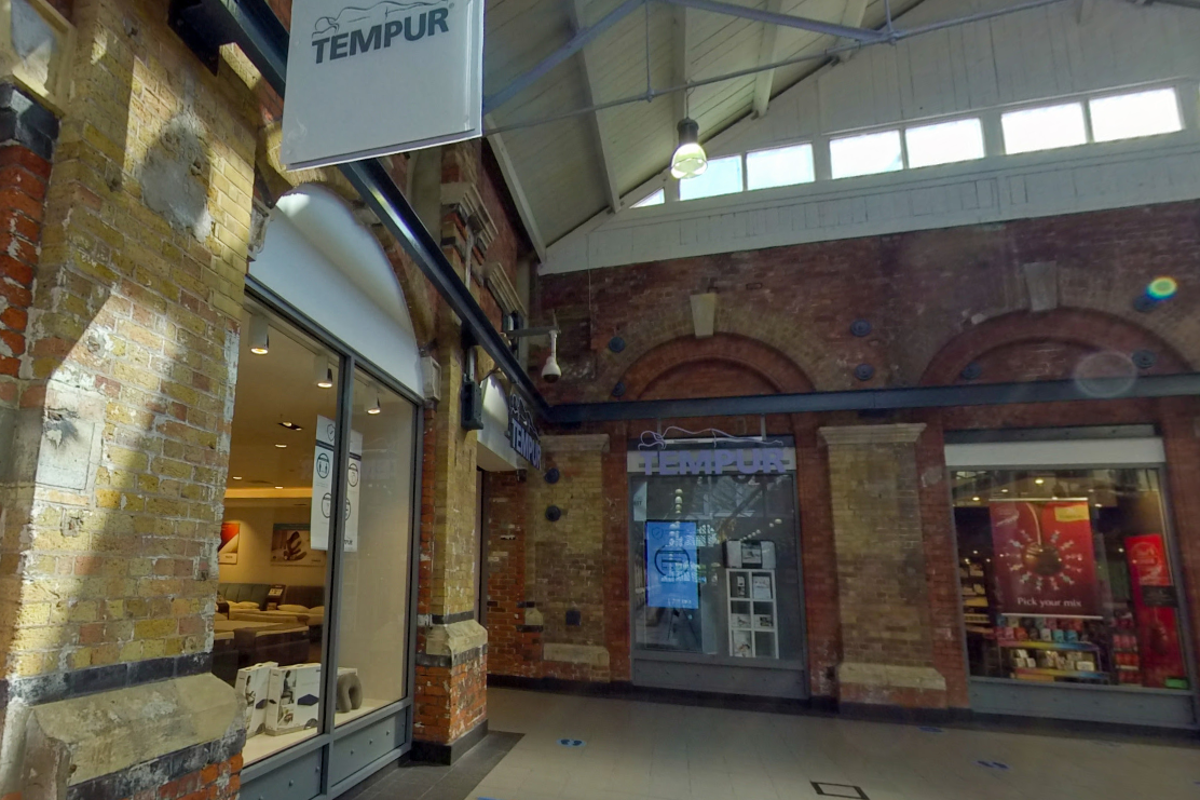
A worker at a UK mattress company sued for disability discrimination after she claimed a mattress fell on her and gave her brain damage.
Tempur worker Lee Hardy was knocked into a brick wall by the mattress but did not go home after the incident - despite suffering a 'traumatic brain injury'.
She said the injury had made her depressed, but Tempur believed she had suffered from depression before the accident.
She later claimed she was harassed by the company as they did not let her boyfriend visit her at work and they investigated her when they thought she had lied to get a discount on a mattress.
Eventually Mrs Hardy quit her job and claimed she had been forced to do it by the bosses' treatment of her.
However it was found that she had really left because she had already lined up her next job and her claims were dismissed.
Mrs Hardy started working for Tempur in February 2016 as a Brand Specialist at the Swindon store, Wilts.
On June 25, 2023, Mrs Hardy was injured at work 'when a mattress fell and knocked her into a brick wall'.
No first aid was offered on the day and she even completed her shift - but then went to hospital before going off work until September.
The injury was described as 'a traumatic brain injury' and afterwards Mrs Hardy said she 'developed persistent concussion syndrome, chronic depression, complex PTSD, cognitive impairment, speech difficulties, severe fatigue, sensory sensitivity, suicidal ideation, and absence seizures'.
Mrs Hardy also said that the symptoms 'significantly affected her ability to carry out day-to-day activities, including communication, concentration, mobility, and medication management'.
Tempur's occupational health report said that Mrs Hardy should be treated as disabled.
The company accepted that she was but contested whether it was due to the mattress falling on her.
Mrs Hardy made three disclosures between June and September - one to the Health and Safety Executive, one to Swindon Borough Council Environmental Health, and one to the company's HR manager.
They were 'reporting unsafe manual handling practices, lack of lifting aid, and the accident'.
A phased return to work was agreed whereby Mrs Hardy would work '16 hours a week over four days' with 'no lone trading, no late-night shifts, no physical exertion, and her progress was to be reviewed every two weeks'.
On September 8, 2023, she requested two hours of leave at the end of a shift due to unforeseen childcare circumstances but was refused.
She reminded managers that there had never been a problem with staff taking holiday before, even on Black Friday, but she was still refused.
Her partner, who had been dismissed from Tempur for gross misconduct, had also been seen in the store and managers reminded Mrs Hardy that he was not allowed inside.
However he was her registered carer and she thought this was discriminatory.
In January 2024, Mrs Hardy tried to make a staff purchase of a mattress but in response to her request she was asked if she had permission from a manager.
She said yes and asked if she was even allowed to make staff purchases as she always hit 'roadblocks', but the manager had not yet approved her request.
Richard Geen, who handled the request, told her that he was not 'intentionally put roadblocks' in her way but felt that she had 'lied' about having approval in order to make the purchase - even though her request was eventually approved.
Mrs Hardy told him that she was sorry for the 'confusion' and that: "Unfortunately this is quite a common occurrence with the side effects of my head injury."
However Mr Geen started an investigation to get to the bottom of whether she had 'lied' in February 2024.
Mrs Hardy said she "did not understand why her staff order required that level of scrutiny and oversight."
She stated that 'she felt it was harassment targeted towards her and that it wouldn’t happen to other colleagues'.
The investigation ended and Mr Geen ultimately accepted her explanation of what happened - that the email was sent by mistake.
However by the end of April 2024 Mrs Hardy had been offered the role of Assistant Shop Manager at children's hospice charity Julia's House.
In mid-March she sent a letter of resignation to Tempur.
She cited: "I am resigning in response to a repudiatory breach of contract by Tempur UK LTD and I therefore consider myself constructively dismissed.
"I have made a formal case with the ethics line regarding the breach of contract and harassment but received no meaningful response from any part of the company.
"The continued stress of being an employee of Tempur is having severe effects on my health and wellbeing, which the company is not taking into consideration at all.
"I also made a formal request for reasonable adjustments in the workplace which has been ignored and I have not received any response to the letter.
"I now consider that my position at Tempur is untenable and my working conditions intolerable, leaving me no option but to resign in response to the company’s breach."
She submitted claims of constructive dismissal, disability discrimination, harassment, and whistleblowing detriments to an employment tribunal in Reading.
However Employment Judge Andrew Gumbiti-Zimuto dismissed her claims.
He concluded: "[Mrs Hardy] denies that she intended to resign her employment with [Tempur] to take up employment with Julia House, however it appears to me that it is more likely than not that she did just that.
"[Tempur] submits that [Mrs Hardy] resigned in order to take up employment with Julia’s House, not because of any repudiatory breach.
"It is not clear to me that the way that [Mrs Hardy] explains her reasons for resigning in the resignation letter aligns with the case that has been presented to the Tribunal on constructive dismissal.
"There is no constructive dismissal in this case because there was no repudiatory breach of contract by [Tempur] and in any event [Mrs Hardy] did not resign her employment in response to any repudiatory breach.
"There was no constructive dismissal. [Mrs Hardy's] complaints of constructive dismissal, disability discrimination, harassment, and whistleblowing detriments are not well founded and are dismissed."